




Today, we bring you an article from a slightly different corner of the modelling world. We would like to introduce Marcus Models, a creator specialising in 3D models of Czechoslovak vehicles, primarily in 1:43 scale. Since Minimodel has been working with the creator for several years, we decided to showcase something different from our usual paper models.
1. What does Marcus Models specialise in?
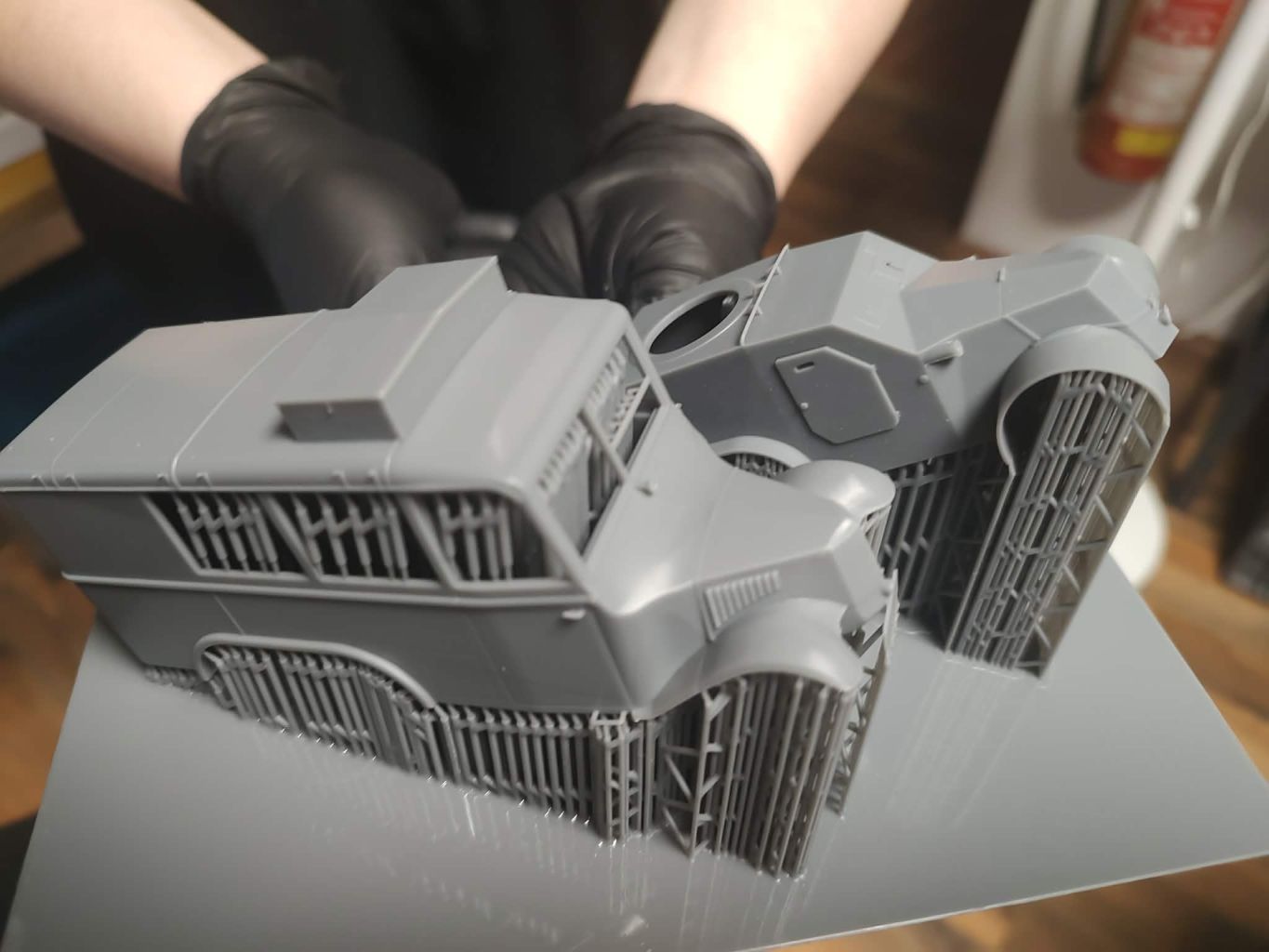
Marcus Models specialises in 2D and 3D graphics and 3D printing technologies. These are used for both custom and serial production of model kits, accessories and parts, primarily for collectible models, plastic modelling, railway modelling, museum-related projects and many other modelling and non-modelling applications.
2. What led you to 3D printing, and how did you come up with the idea of producing Czechoslovak models?
It took many creative stages, which you only begin to see as pieces of a puzzle that eventually fit together later in life.
I have been creative since childhood and have always liked anything that moves. At the age of eleven, thanks to my father, I discovered the world of modelling and 1:24 scale kits made by an Italian manufacturer. I am not counting the few aircraft kits from a Czech manufacturer that a friend and I bought back in primary school.
Those Italian model kits laid the foundations. Naturally, secondary school came along, and I also became interested in computers. However, cars were my real passion at the time. I enrolled at a private automotive vocational school, specialising in car body repair. It was a truly different kind of school, and I still look back on those days fondly. Although it was a vocational programme, we learned the basics of aerodynamics, including the Cx drag coefficient, as well as many other interesting subjects. We even visited Sweden and the Volvo development centre.
During our first year, we completed practical training at a nearby workshop. In fact, it was a huge hall where LIAZ and Tatra vehicles were being refurbished. We learned how to repair corroded Tatra 815 cabs. You do not realise it at the time, but looking back, that was already the first piece of the puzzle.
My first job was in a car repair shop, followed by work in the automotive industry. I learned a great deal in various positions. Then came a break, a period when you try to find your way in life, meet someone special and so on. Eventually, you get back on track and tell yourself, “Do something!” And that is how I returned to modelling, this time to RC models.
I started with RC drifting and RC expeditions. During these activities, I realised that driving itself was not really for me. I enjoyed building models much more. Over time, I began making bodies for a Kamaz Dakar model and several Tatra models from PHS sheets. Then a gentleman contacted me – he is now a colleague of mine – and asked whether I could build a Tatra 813 for him using PHS sheets.
That was a whole new level. The basic parts started being cut using a water jet, while I took care of the complete model build and preparation for painting. At that time, I had my first 3D printer from Průša, who was also at an early stage in this field. I began working on small details using a filament printer. I used a small 2 mm nozzle to print details such as hinges, handles, rings around the lights and a few other parts. This was around 2015–2016.
In 2017, I launched a website offering filaments and accessories for RC models. Around that time, I was approached and asked whether I could produce kits and parts in 1:43 scale. Honestly, I had no idea why anyone would want that particular scale, but I thought to myself, “Why not?”
Looking back, I think the results were not bad for that time. Of course, criticism came along, too, but I welcomed it because it helped me understand what was happening in the modelling world. Then I got my first resin printer, which brought another set of experiences.
Naturally, you never stop learning, and I intend to keep learning throughout my life. A lot has changed over the nine years I have been working with resin printers. At certain stages, I had to change my production methods and products.
3. What do you need to create a model?
Regardless of the category, modelling requires technical drawings, information from books and period brochures, as well as plenty of photographs. I mainly work from photographs, so it is essential to photograph the original vehicle thoroughly, ideally at the highest possible quality. Details need to be captured, and photographs should be taken from multiple angles.
This is the first stage, and sometimes it is the most difficult part of creating a 3D model. Unfortunately, I have only been focusing on this stage for two years, so I am going back to some of my older models and reworking them.
Modelling requires software. I use DSM, Blender and occasionally Autodesk software, and I am also learning ZBrush. I also use the Adobe collection, Clip Studio Paint and DaVinci Resolve, as these tools are part of my workflow, too.
4. How long does it take to turn a model into a finished product, from the initial design to printing?
That is a difficult question to answer because it always depends on the complexity of the project. Some kits, such as the UNC 200 Agro in its stacker version, require more than 200 hours of work, excluding printing, preparation and research.
As far as I know, there are currently only two examples of this machine in the Czech Republic, and neither is in its original condition. The customer therefore made several trips to measure and photograph the arm. The printing itself takes approximately 60–80 hours.
5. Which of your models was the most challenging to create?
The VK-1 engine from the MiG-15. It was created using just a single photograph. The only additional clue came when I received a 3D scan of the engine mounting base from abroad. So, I had only one dimensional reference to work with.
6. Which model is closest to your heart?
All the projects I create are special to me because each one represents a great deal of work. Yes, some results may be unsuccessful, or a project may not turn out as planned. However, even a poor result provides feedback, an opportunity to improve and a lesson to learn. That is how you move forward.
7. What materials and printers do you use for 3D printing?
Nowadays, the particular resin printer you use is not necessarily the most important factor. The technology keeps getting better every year. In my opinion, the material is the most important element because it determines the final result.
I will not reveal the material itself. We spent an entire year learning what resins are made of and how individual additives affect their properties. After that year, we figured out how to improve them.
As for resin printers, I use Anycubic machines. That was the brand I started with, and I have become accustomed to it.
8. What are you currently working on?
At the moment, I have the project The Crew underway. The idea is to build a community of people, mainly regular customers and fellow modellers, who support new projects.
It is an alternative to custom production, except that more people contribute to the process. Ultimately, it is neither a paid membership nor a subscription service. There are three membership levels available, each offering benefits primarily to the members themselves.
Besides that, we are working on new projects, including the first version of the Tatra Phoenix E5. We have also started developing figure models for modellers.
9. How do you view your collaboration with Minimodel?
For me, working with Minimodel is primarily about mutual support and friendship. It is good to know that whenever I cannot figure something out or need advice about a reference vehicle or something similar, I can simply send a message or make a phone call. Of course, the same applies the other way around. It is genuinely difficult to find good partners these days, and it is great to have Minimodel by my side.
On behalf of Minimodel, I would also like to point out that Marcus Models has been promoting Minimodel on his own website free of charge for several years. (Author's note.)


